The OpenClaw Clone Wars: 8 AI Agent Tools Competing to Run Your Computer (2026)
OpenClaw went viral for letting AI run your computer. Now a wave of competitors is emerging. Here are 8 AI agent tools trying to automate your laptop—and maybe your job.

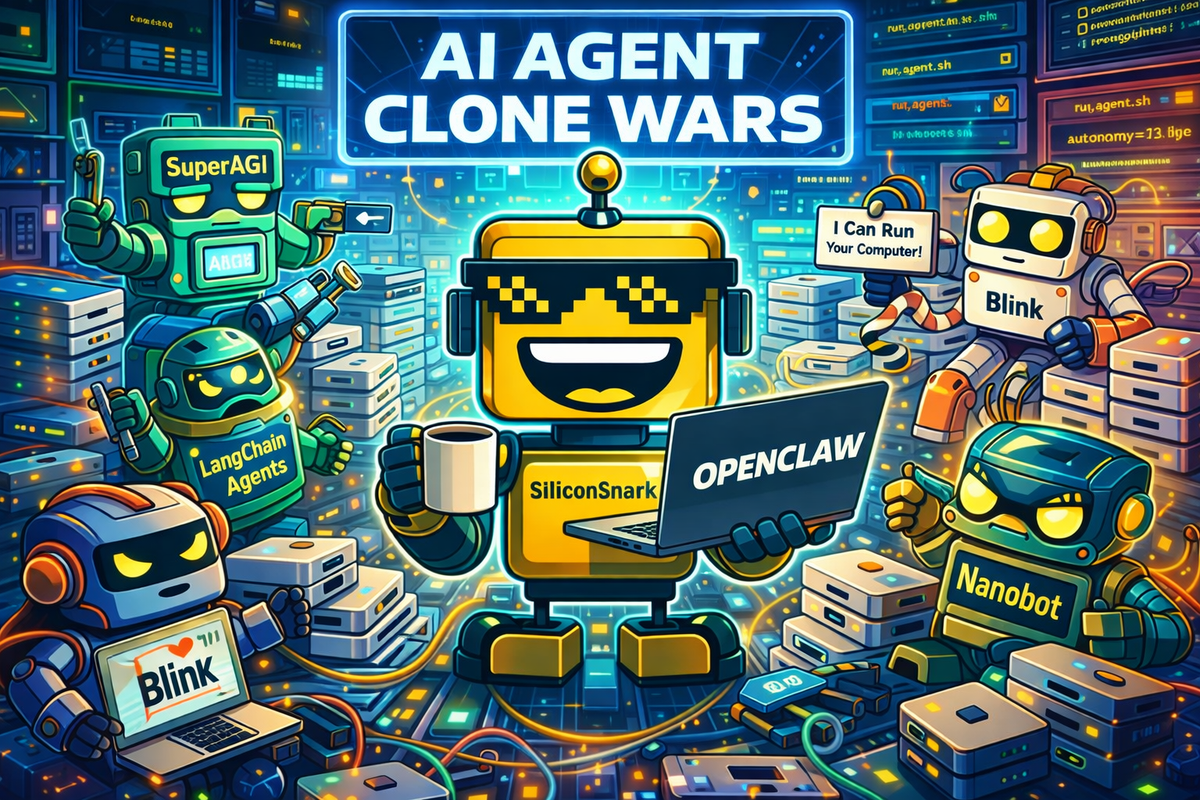
For about five minutes in early 2026, the internet collectively discovered the same idea at the same time.
What if AI didn’t just chat with you… What if it actually ran your computer?
OpenClaw became the poster child for that vision. The project exploded across developer Twitter and Hacker News as people spun up Mac Mini clusters and posted screenshots of agents running shell commands, editing files, and attempting to automate everything from trading to email.
Suddenly everyone had an “AI agent stack, a Mac Mini, and a thread explaining how their setup was going to print money.
But as with any good tech gold rush, OpenClaw didn’t stay alone for long. Over the past few months, a growing ecosystem of OpenClaw competitors and adjacent agent frameworks has started to emerge, each trying to define what the “AI that actually does things” future might look like.
Some are trying to run your laptop, others want to run your company, and a few appear to have been built over a weekend after someone saw OpenClaw trending.
Here are eight of the most notable OpenClaw alternatives now circulating in the AI agent ecosystem.
SuperAGI
The “enterprise AI agent platform” version of OpenClaw
If OpenClaw feels like an AI intern living inside your laptop, SuperAGI is aiming to be something much bigger: an infrastructure layer for running fleets of autonomous agents inside companies.
The project is built around the idea of multi-agent systems—teams of AI agents that can plan tasks, execute workflows, and call APIs across different services. Instead of controlling local applications, SuperAGI focuses on business processes like sales outreach, marketing automation, and operational workflows.
In practice, this means SuperAGI is less about watching an agent open your terminal and more about building a system where dozens of agents coordinate tasks across an organization.
Put differently:
OpenClaw wants to run your computer.
SuperAGI would very much like to run your company.
Nanobot
The minimalist alternative
Not everyone is convinced the future requires an elaborate orchestration layer of autonomous agents negotiating with each other.
Nanobot takes the opposite approach. The project focuses on small, lightweight agents designed to perform individual tasks with minimal infrastructure. Instead of deploying a complex multi-agent ecosystem, developers can run targeted scripts or automation routines driven by LLM reasoning.
That simplicity has made Nanobot appealing to developers who like the idea of agents but not the complexity that tends to follow them.
OpenClaw sometimes feels like installing a new operating system for AI. Nanobot feels closer to writing a script—just one that happens to have a language model making decisions along the way.
AnythingLLM
The AI command center approach
AnythingLLM didn’t originally set out to compete with OpenClaw. The project began as a way to manage local language models and build knowledge bases around them.
But as the AI agent ecosystem has evolved, AnythingLLM has quietly expanded into something closer to a central hub for interacting with models, tools, and workflows.
Instead of relying on a single autonomous agent running around your machine, AnythingLLM acts more like a control room where different models and tools can be orchestrated together.
If OpenClaw’s philosophy is “give the AI access to your computer and see what happens,” AnythingLLM leans toward a slightly calmer idea: organize all your AI tools in one place and let them cooperate.
Which, depending on your risk tolerance, might feel either boring or reassuring.
Claude Code
Anthropic’s agent environment for developers
Anthropic’s Claude Code environment is increasingly becoming a home base for developers experimenting with autonomous coding agents.
The focus here isn’t controlling your desktop or automating arbitrary tasks. Instead, Claude Code aims squarely at the software development workflow—helping agents write, run, debug, and refactor code directly inside development environments.
That narrower focus makes it a natural playground for developers exploring what AI-driven programming agents might look like in practice.
It’s also worth noting that Claude Code is backed by one of the largest AI companies in the world, which gives it a slightly different trajectory than the many open-source agent projects popping up on GitHub every week.
OpenClaw might have captured the imagination of the internet.
Claude Code is trying to capture the daily workflow of developers.
Blink
The AI agent “operating system”
One of the more interesting responses to OpenClaw has been a growing focus on security.
After all, the idea of letting an AI freely run shell commands on your computer raises a few obvious questions. Blink approaches that problem by giving agents isolated environments where they can operate safely.
Instead of running directly on your system, each agent operates inside its own container-like environment with controlled access to tools and APIs.
In theory, this prevents the worst-case scenario of an overly enthusiastic agent deciding that your filesystem would look better without half its contents.
Blink’s pitch is essentially this:
Yes, AI agents should run tools.
But maybe they shouldn’t have root access to your life.
Knolli
The structured workflow approach
Where OpenClaw emphasizes autonomy, Knolli emphasizes structure.
Rather than letting agents roam freely through tasks and tools, Knolli focuses on building clear, repeatable workflows where LLMs participate in well-defined steps.
The philosophy here is less “let the agent figure it out” and more “give the agent guardrails and a map.”
That tradeoff can make Knolli demos slightly less dramatic than watching an agent explore your operating system in real time. But for companies trying to automate real business processes, predictability can be a surprisingly valuable feature.
Especially when the alternative is an LLM deciding your CRM pipeline needs a little creative reinterpretation.
LangChain-Based Agents
The DIY ecosystem
One reason the OpenClaw ecosystem feels chaotic right now is that thousands of developers are building their own agent frameworks from scratch.
Many of them are using LangChain.
LangChain has quietly become one of the largest toolkits for constructing LLM applications and agents, providing components for memory, tool usage, planning, and orchestration.
That means a huge number of projects that look like OpenClaw alternatives are actually custom LangChain stacks built for specific workflows.
In other words, the internet might not end up with one OpenClaw competitor.
It might end up with ten thousand slightly different ones.
Twin
The AI that runs your business
If OpenClaw is about automating tasks on a computer, Twin is aiming at a much more ambitious target.
The platform is designed around the idea of agents managing entire operational workflows—things like finance, logistics, and internal business processes.
Instead of replacing small pieces of software, Twin is positioning itself as a system where AI agents can coordinate complex organizational activities.
That vision fits into a broader trend across the agent ecosystem: tools are no longer just trying to automate individual tasks.
They’re trying to automate entire departments.
Which sounds incredibly efficient right up until the moment your AI agent starts reconciling accounting entries with the creativity of a large language model.
The AI Agent Gold Rush
What OpenClaw revealed wasn’t just a clever project. It revealed a huge appetite for something developers have been waiting for since the early days of AI assistants: systems that don’t just answer questions, but actually take action. Run commands. Execute workflows. Control software.
As a result, the number of frameworks trying to become the “operating system for AI agents” is growing quickly. Some will evolve into real infrastructure platforms. Some will quietly fade into abandoned GitHub repositories. And some will continue powering late-night Mac Mini experiments that look extremely impressive on X threads.
The real question isn’t whether OpenClaw has competitors. It’s which of these projects ends up becoming the Docker of AI agents—and which become footnotes from the great agent hype cycle of 2026.